
Core: Lateral Focus
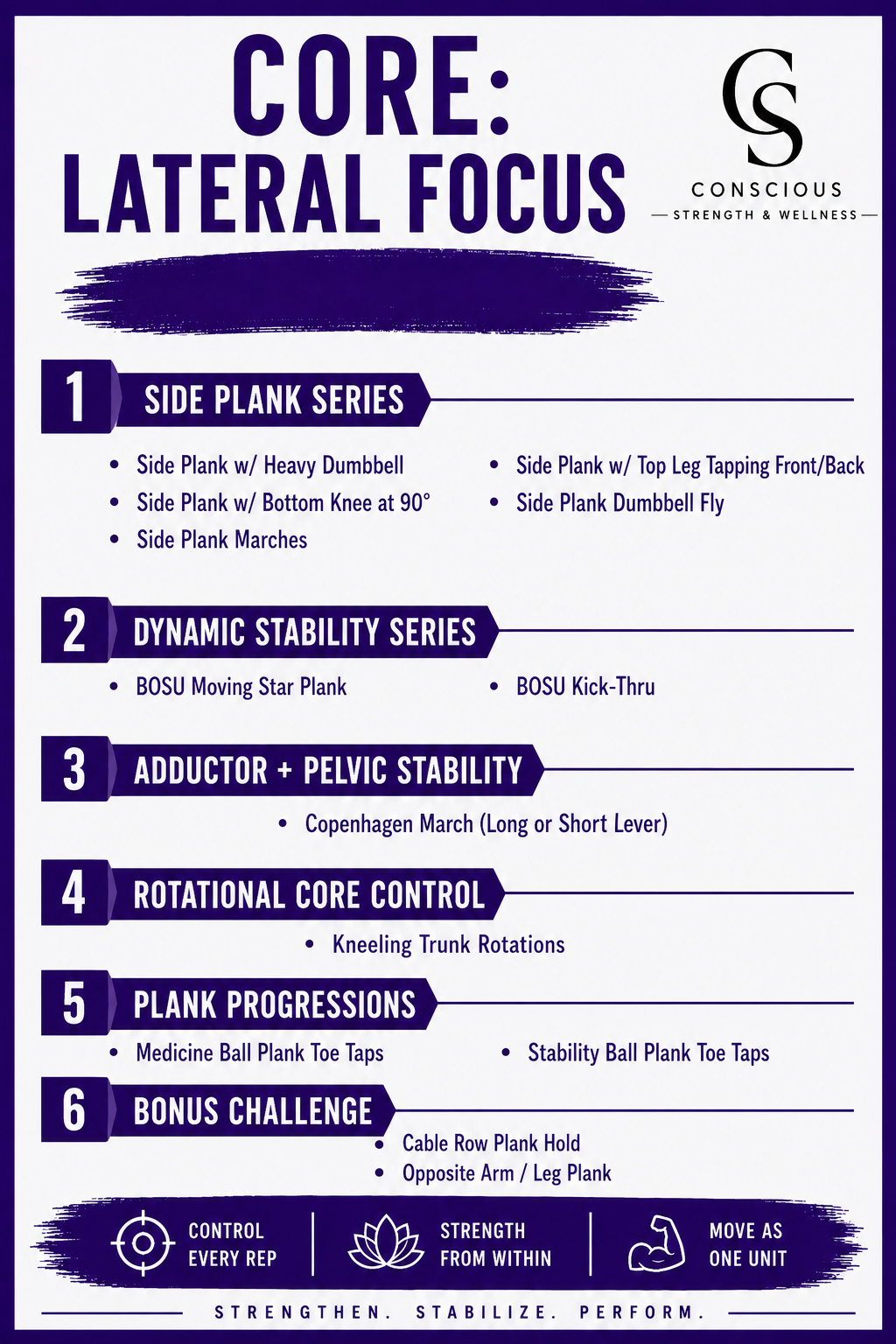
Scroll down for video demonstrations of the exercises. Some movement names may be unfamiliar, but the videos show you exactly how to perform them.
A strong, functional core also relies heavily on the lateral core muscles, which are the muscles along the sides of your torso that control side-to-side stability, rotation, and anti-rotation.
The primary lateral core muscles include the internal obliques, external obliques, and the quadratus lumborum.
These muscles work together to stabilize your spine, control rotational movement, and help your body resist collapsing or twisting under load.
They are especially active during exercises like side planks, rotational movements, and single-leg stability work (like walking and running).
Why Lateral Core Strength Matters
Stability and Injury Prevention
Your lateral core acts as a support system for your spine and pelvis. When these muscles are strong, they help keep your body aligned and stable during movement. This reduces unnecessary strain on the lower back and hips and helps protect against common injuries. Weak lateral core muscles often lead to excessive side bending or rotation, which can overload the spine.
Power Transfer in Sports
Many athletic movements rely on rotation or resisting rotation. Running, throwing, swinging a golf club or tennis racket, and even changing direction all require strong obliques to transfer force efficiently through the body. The lateral core connects the upper and lower body, allowing power generated by the legs to move through the torso and into the arms.
Balance and Single-Leg Strength
Walking, running, climbing stairs, and most athletic movements happen on one leg at a time. Your lateral core stabilizes the pelvis, so it doesn’t drop or shift excessively during these movements. Without this support, the body compensates elsewhere—often in the knees or lower back, causing chronic pain.
Everyday Life Strength
Lateral core muscles are constantly working during daily activities. Carrying groceries in one hand, reaching for something on a high shelf, twisting to grab something from the back seat, or even maintaining upright posture all rely on these muscles. Training them helps make everyday movements feel stronger and more controlled.
Why This Workout Works
This workout focuses on side plank variations and controlled rotation, two of the most effective ways to train the lateral core. Side planks build deep stability by teaching the body to resist collapsing sideways, while rotational movements strengthen the obliques’ ability to create and control twisting motion.
Together, these exercises build a core that isn’t just strong in one direction, but stable, resilient, and capable of handling real-world movement—whether that’s improving athletic performance or simply helping you move through daily life with better balance and control.
Equipment needed: dumbbells, BOSU, medicine ball, stability ball, cable, weight bench
Exercise Demos Included: New to a movement? No problem. Click any exercise name to watch a quick video demo so you can feel confident before you start.
The Workout
Move through the exercises in the order listed below to build the progression of core stability.
Side Plank Series
Perform each exercise for :30 seconds per side.
Side Plank with Heavy Dumbbell
Hold a heavy dumbbell straight up to challenge shoulder stability and full-body tension.Side Plank – Bottom Knee at 90°
Bottom knee bent at 90° to help reinforce proper pelvic alignment while still training the lateral core. This will also engage the adductor muscles that help stabilize the pelvis.Side Plank Marches
Alternate marching the legs while keeping hips stacked.Side Plank with Top Leg Tapping Up and Over Bottom Leg
Tap the top leg forward and back over the bottom leg while maintaining a stable torso.Side Plank Dumbbell Fly
Hold a light dumbbell and perform a controlled fly motion while maintaining plank stability.
Dynamic Stability Series
BOSU Star Plank – 8-12 reps per side
Feet on the BOSU while raising and lowering leg to challenge stability.The BOSU adds instability which requires more core muscle activation. If you do not have a BOSU, these can be performed with your feet on the floor.
BOSU Kick-Throughs – 10 reps per side
From a plank position holding on to the BOSU, rotate the hips and kick one leg through under the body.This can be done on yoga blocks or a step platform if you do not have a BOSU. It won’t give the same instability option, but it does allow movement at the pelvis while keeping the torso braced.
Adductor + Pelvic Stability
Copenhagen March – Long Lever– 20 marches per side
Support your top leg on a bench and perform controlled marching movements.
Option if the long-lever variation is not yet manageable:
• Copenhagen – Short Lever (bent knee version)
Rotational Core Control
Kneeling Trunk Rotations – 20 reps per side
Slow, controlled rotations focusing on resisting momentum.
Plank Progression
Medicine Ball Plank Toe Taps – 10 reps per side (total of 20 taps)
Hands on a med ball while alternating toe taps.Stability Ball Plank Toe Taps – 10 reps per side (total of 20 taps)
Hands on a stability ball while tapping feet side to side, no dipping or twisting.
Bonus Challenges
Cable Row Plank Hold – :30 seconds each arm
Hold a plank while isometrically maintaining a single-arm cable row position.Opposite Arm/Leg Plank – :30 seconds each side
Lift one arm and the opposite leg while maintaining a stable trunk.
