
Upper Body Strength Endurance
Scroll down for video demonstrations of the exercises. Some movement names may be unfamiliar, but the videos show you exactly how to perform them.
Build strength that lasts — not just strength that peaks.
This workout is designed to challenge the muscles of the upper body through high-repetition, controlled strength work rather than maximal loading.
Instead of chasing heavier and heavier weights, the goal is to create long periods of muscular tension by moving deliberately and resisting the urge to rush through the reps.
The result?
✅ Improved muscular endurance
✅ Increased joint stability
✅ Better posture and shoulder health
✅ Greater fatigue resistance
✅ Real-world strength that carries over to work, sport, and everyday life
For runners and endurance athletes, this type of training is especially valuable because your body doesn't just need to produce force, it needs to produce force repeatedly without breaking down.
Why This Works
1. Time Under Tension Builds Strength
Muscles respond to tension, effort, and fatigue, not simply the number printed on the dumbbell.
By slowing the movement and controlling every inch of every rep, you dramatically increase the amount of time the muscles spend under tension, creating a powerful strength stimulus even without maximal loads.
2. Endurance Athletes Need Muscular Endurance
Distance running, cycling, rowing, hiking, and other endurance sports require muscles to contract thousands of times over long periods.
Muscular endurance training teaches the body to maintain posture, control, and force production long after fatigue sets in.
This is often the difference between holding form late in an event and watching mechanics fall apart.
3. Shoulder Health Requires More Than Pressing
The combination of pressing, raising, curling, and triceps work challenges the upper body from multiple angles while also asking the stabilizers of the shoulder and scapula to contribute.
The Bent Y-T Raises in particular target muscles that are often neglected in traditional upper body training but are critical for:
Shoulder health
Posture
Scapular control
Overhead strength
Injury prevention
4. Slow Reps Build Control
Anyone can move a weight quickly.
Control is harder.
Slow repetitions improve body awareness, joint positioning, and movement quality while reducing the tendency to rely on momentum.
Strength without control rarely transfers well to sport or life.
Best For
✔ Runners and endurance athletes
✔ Building upper body muscular endurance
✔ Improving shoulder health and posture
✔ Increasing fatigue resistance
✔ General fitness and longevity training
Equipment needed: dumbbells, bench (optional, as chest and triceps work can be done on the floor)
The Workout
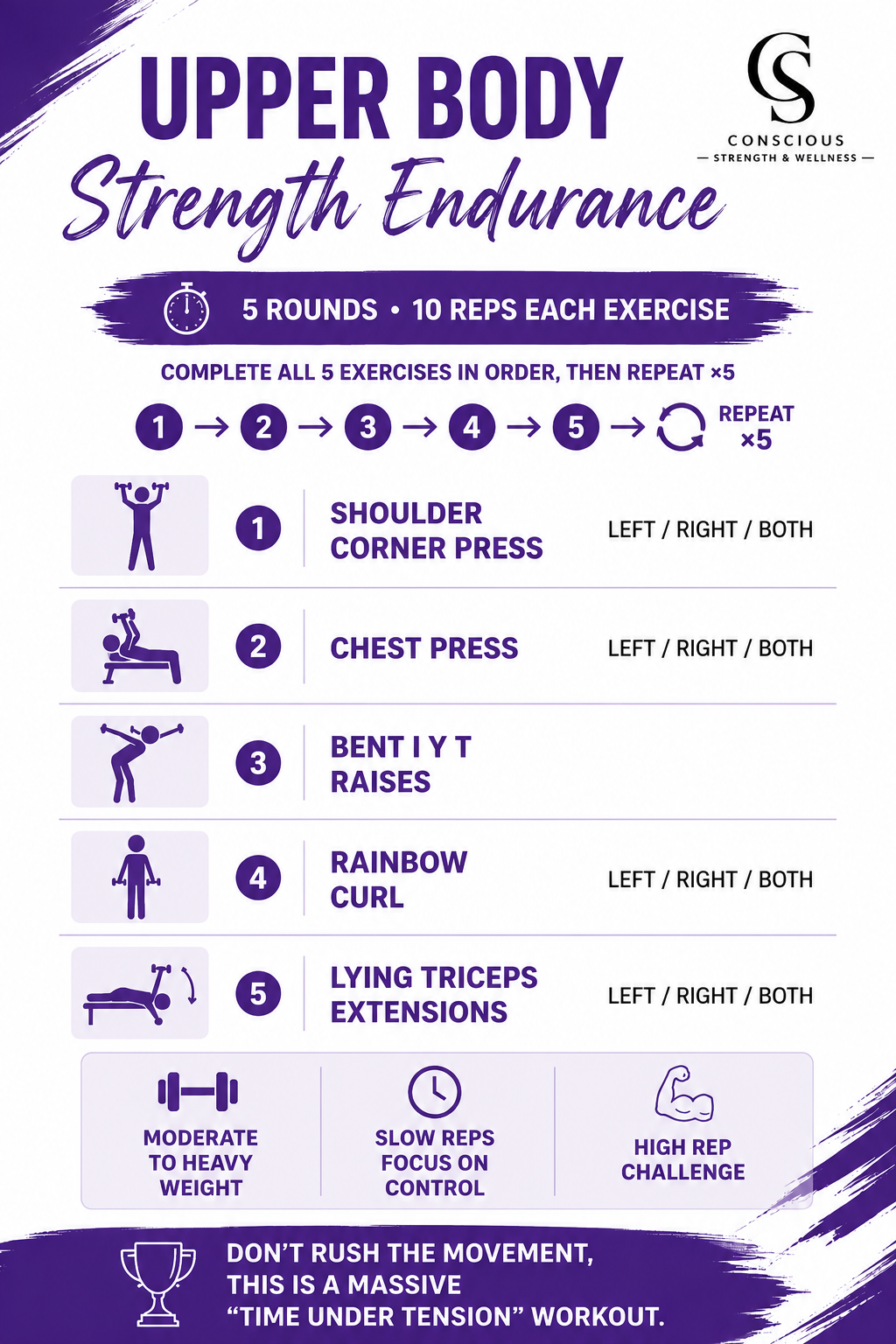
Complete all 5 exercises 1-5 in order, then repeat for 5 total rounds.
10 reps each exercise
Shoulder Corner Press (Left → Right → Both)
Chest Press (Left → Right → Both)
Rainbow Curl (Left → Right → Both)
Lying Triceps Extensions (Left → Right → Both)
Goal:
5 rounds total
Moderate to heavy weight
Slow, controlled repetitions
Minimize momentum
Focus on quality movement over speed
Coaching Notes
Choose a weight that makes the final few reps of each set challenging while still allowing perfect technique.
If your form breaks down, reduce the weight before increasing momentum.
Move deliberately on both the lifting and lowering portions of each repetition.
Your shoulders, chest, arms, and upper back should all feel involved by the end of each round.
